Quick answer
As an Australian tradie, your invoice needs your ABN, business name, a unique invoice number, the job/site address, separate line items for labour and materials, GST if you’re registered, a clear due date, and your bank details. Send it as a PDF the same day the job wraps. Big jobs get split into deposit + progress + final claims; small jobs are a single invoice. That’s the whole playbook - the rest is detail.
What a tradie invoice has that a general invoice doesn’t
Tradies have some extras over a generic freelance invoice:
- Site address. Every invoice should state the address where the work was done, especially for any construction, renovation, or compliance-impacting work. The site address is what links the invoice to the building record and the warranty.
- Labour vs materials split. Listed as separate line items, ideally with quantity (hours for labour, units for materials) and unit rate. This is the single biggest dispute-prevention move.
- Job reference / quote number. If the work was quoted, the invoice should reference the quote number. Lets the client’s bookkeeper match the invoice to the approved scope.
- Licence numbers where required. Licensed trades (electrical, plumbing, gasfitting) put their licence number on the invoice as a matter of course. Required in some states for warranty enforcement.
- Deposit and progress references. Final invoices on bigger jobs subtract already-paid deposits and progress claims so the balance owing is unambiguous.
Step 1: Get the ABN side sorted
Before any invoice goes out, you need an ABN. Without one, your client must legally withhold 47% of the payment for tax - on a $5,000 invoice, that’s $2,350 you don’t see until tax time. ABNs are free, online at abr.gov.au, and approved instantly in most cases. Full details in do you need an ABN to invoice?
Step 2: Decide on GST
If your turnover is at or above $75,000 in any 12-month period, GST registration is mandatory and your invoices become “Tax Invoices” with a 10% GST line. The complete field list, including tradie-specific extras like licence numbers and site addresses, is in our guide to the ATO tax invoice requirements for tradies.
- How to add GST to a tradie invoice covers the calculation, wording, and rounding.
- How to invoice without GST covers what under-threshold tradies must (and must not) put on the invoice.
Step 3: Structure the line items properly
A small job example for a sparkie installing two power points:
Labour — install 2x double power points (2 hr)        $180.00
Materials — 2x Clipsal double GPO, cable, fixings    $ 65.00

Subtotal:                                              $245.00
GST (10%):                                             $ 24.50
Total (AUD):                                           $269.50
For a larger job, give the line items more breathing room - one row per major task or area:
Labour — bathroom rough-in (12 hr @ $85)             $1,020.00
Labour — fixture install (8 hr @ $85)                $  680.00
Materials — pipework, fittings, brass               $  430.00
Materials — tap set, mixer, shower head             $  690.00
Site allowance — inner-city parking permits         $   40.00

Subtotal:                                              $2,860.00
GST (10%):                                             $  286.00
Total (AUD):                                           $3,146.00
The point isn’t to itemise every screw - it’s to give the client enough detail that the price feels justified. “Labour” on its own with a single $1,700 figure makes clients query the bill. Eight hours at $85 each line, with a clear task next to it, doesn’t.
Step 4: Handle deposits cleanly
Deposits exist to secure your time and cover up-front material costs. The pattern most tradies use:
- Deposit invoice. A short invoice issued before work starts, requesting the deposit (typically 10–30% of the quoted total). Marked clearly: “DEPOSIT INVOICE” or “REQUEST FOR DEPOSIT”. References the original quote.
- Final invoice. After the job is complete, you issue the final invoice for the full job total, with a line subtracting the deposit already paid. The balance owing is what the client pays now.
Full details and email wording in how to invoice for a deposit.
Step 5: Progress invoices for bigger jobs
On jobs that run for weeks or months - bathroom renovations, deck builds, full rewires - you don’t wait until the end to invoice. Progress claims bill the client at agreed milestones:
- Stage-based: “Stage 2 of 4 - first fix complete”. Each stage maps to a percentage of the total contract.
- Time-based: weekly or fortnightly progress invoices for long-running work, often based on time-and-materials so far.
Each progress invoice references the contract total and shows the running balance. The final invoice closes everything out: total contract minus all prior payments equals what’s owed now.
The covering email matters
Even the best tradie invoice gets lost if the email is wrong. The pattern:
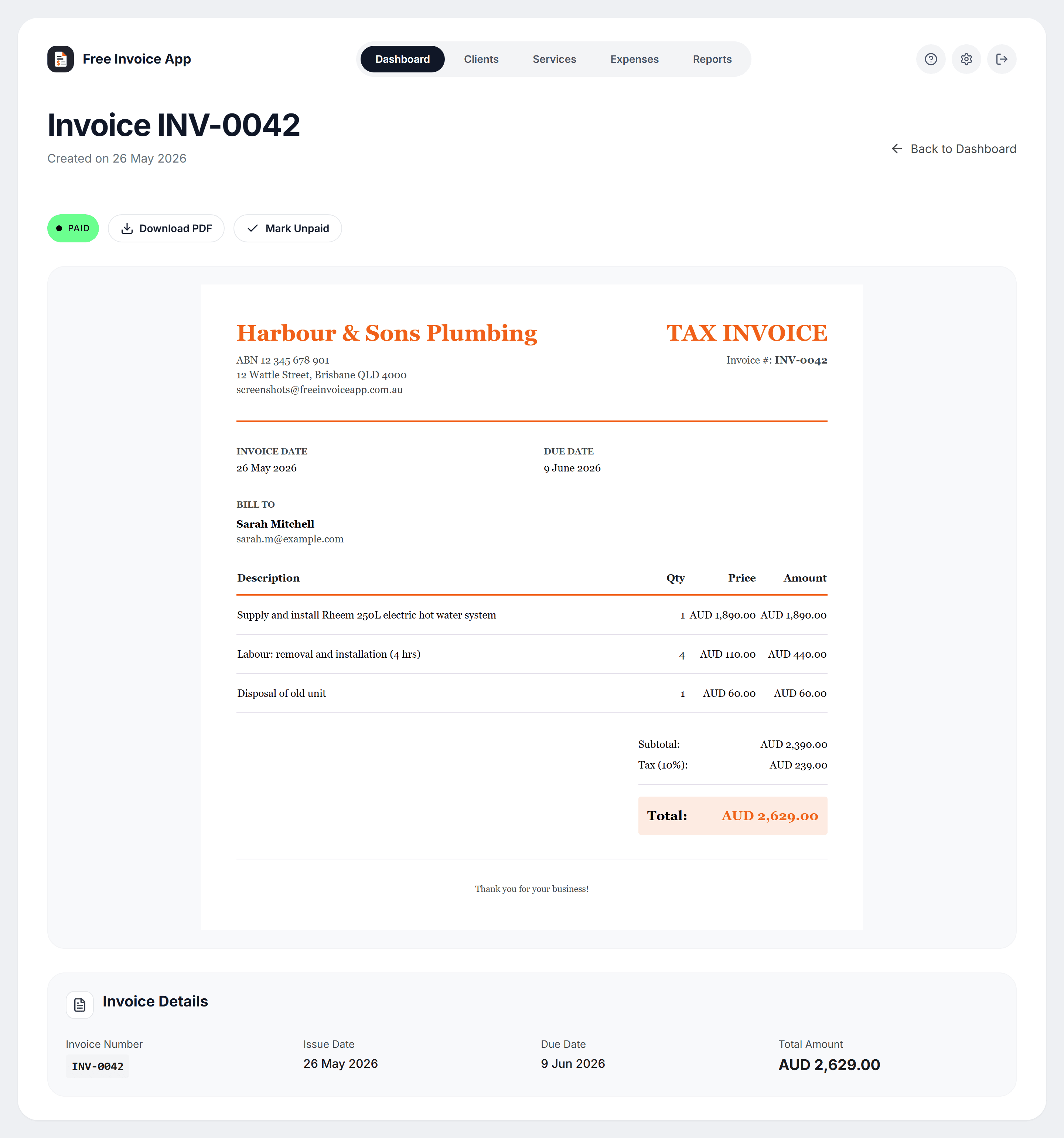
Subject: Invoice INV-0042 — [Site address] — Due 18 June 2026

Hi [Client first name],

Job’s done at [site address] — thanks for the work.

Attached is invoice INV-0042 for $[amount], due [due date].

Payment:
   BSB / Account: 000-000 / 000 000 000
   Account name: [Your Business Name]
   PayID: [phone or email]

Let me know if anything needs adjusting.

Cheers,
[Your name]
ABN [your ABN]
[Licence number, if applicable]
Subject line wins matter: amount, site, and due date in the subject means the client (or their bookkeeper) can triage the email in seconds. Full guidance in how to invoice a client for the first time.
Getting paid: terms that work for trades
Net 7 or Net 14 is standard for tradies billing domestic clients. Builders and commercial clients often have Net 30 in their own systems - if you can negotiate Net 14 in writing up front, take it. Late payment chases are vastly easier when the due date is unambiguous. See payment terms in Australia for the conventions, and following up overdue invoices for the email cadence that works.
Record-keeping for tradies
Every invoice you issue must be kept for at least 5 years per the ATO - see how long to keep invoices. For tradies that also means keeping copies of receipts for materials, sub-contractor invoices, and any compliance paperwork (test & tag records, certificates of compliance, gas/electrical safety certs). Digital is fine and far easier than the glovebox archive.
How Free Invoice App handles tradie invoicing
Free Invoice App is built mobile-first - create and send an invoice from the ute the same day a job wraps. Line items support labour and materials side-by-side with their own quantities and rates. GST toggles per line (useful for mixed jobs where some materials are on-supply). Deposits and progress claims are first-class. Your ABN, licence number, and payment details are filled in once during setup and appear on every invoice automatically. Get started free - the Starter plan covers 7 sends a month at no cost.
Frequently asked questions
Do tradies have to charge GST?
Only when GST-registered, which is mandatory once turnover hits $75,000 in any 12-month period. Below that, no GST line, no “Tax Invoice” wording.
Can I invoice without a trade licence?
The invoice itself doesn’t need a licence. The work often does - electrical, plumbing, gasfitting are licensed in every state, and unlicensed work makes the invoice unenforceable.
How do I invoice for a deposit?
Issue a deposit invoice marked clearly “DEPOSIT” before work starts. The final invoice subtracts the deposit and shows the balance owing.
Should labour and materials be on separate lines?
Yes. Separate line items reduce disputes and make audits easier.
What about progress invoices?
For long jobs, claim by milestone. Reference the contract total and show running balance. The final invoice closes it out.
Skip the copy and paste. Send a real invoice in 60 seconds.
Fill in the generator and download an ATO-ready PDF, no account needed. Or sign up and have it emailed, paid by card, and chased for you.
See pricing